

Key Focus
-
Guangzhou Intellectual Property Court concludes copyright infringement case involving a private server for the mobile game “Wen Dao” — the defendants, who set up and operated a private server for the “Wen Dao” mobile game and a related payment and settlement platform without authorization, shall still bear corresponding civil liability for damages notwithstanding their prior criminal liability for the crime of copyright infringement; the court applied 1.5 times punitive damages and ordered the two principal offenders to pay nearly RMB 3 million in total
-
Guangzhou Intellectual Property Court concludes a copyright infringement case involving an online karaoke APP — clarifying that the online song-on-demand service provided by the platform enables the general public to access the works on demand at a time and place individually chosen, which has the interactive characteristics of communication through an information network and is essentially different from broadcasting, which is characterized by one-way, scheduled reception
-
Tongxiang People’s Procuratorate in Zhejiang Province concludes a series of major online casino cases disguised as an online blind box App — the App built a closed-loop capital flow of “paid box opening – prize-to-token exchange – repeated consumption”, set a random prize mechanism, and further harvested players through exchange loss fees and inflated pricing, which conforms to the core characteristics of gambling
-
Cyberspace Administration of China issues the National Informatization Development Report (2025) — in 2025, the added value of China’s core industries of the digital economy accounted for more than 10.5% of GDP, and revenue of the digital industry reached RMB 39.6 trillion; the number of online audiovisual users reached 1.099 billion; domestic users of micro-short dramas approached 700 million, and the market size exceeded RMB 100 billion
News
- Cyberspace authorities have intensified inspections and enforcement against “self-media” for failure to properly indicate information sources, and reported three typical cases: they have urged websites and platforms to handle 3,704 violating accounts in accordance with laws and platform rules, and to correct more than 48,000 instances of mislabelled or unlabelled short videos; the reported cases cover three types of violations, namely failure to indicate information sources, vague indication of information sources to evade review, and distorted interpretation of current affairs.
- National Press and Publication Administration: In July 2026, a total of 193 domestic online games and 4 imported online games were approved with publication numbers; from January to July 2026, a total of 1,146 online games (1,110 domestic online games and 36 imported online games) obtained publication numbers, an increase of 200 compared with the same period in 2025 (946), representing a year-on-year growth of approximately 21.1%.
- The National Copyright Administration issued the tenth batch of the 2026 key works copyright protection warning list (TV dramas), covering seven TV drama works including “Our Boyhood 2” and “Rising Tides of Rivers and Seas”.
- The General Administration of Sport issued the “15th Five-Year Plan for Building a Strong Sports Nation”: it proposes to strengthen intellectual property protection in the sports field and enhance the commercialization of sports science and technology achievements; to accelerate the development of digital sports, and to support the application of new technologies such as big data, artificial intelligence, and cloud computing in the sports field, so as to enhance the digitalization level of sports products and services.
- Shanghai Municipal Government Information Office: In 2025, enterprises in Shanghai’s culture and related industries achieved operating revenue exceeding RMB 1.4 trillion for the first time; operating revenue of enterprises in new cultural business formats increased by 10.0% year-on-year, accounting for 56.6% of the city’s total cultural revenue; the Shanghai International Film Festival ranked first among A-category international film festivals in terms of screening scale and audience numbers; the China Digital Entertainment Expo & Conference held in Shanghai has become the No. 1 digital interactive entertainment exhibition in Asia and one of the world’s top three digital interactive entertainment exhibitions.
- China Association of Performing Arts: In the first half of 2026, the national box office revenue of commercial performances (excluding performances in entertainment venues) reached RMB 30.408 billion, a year-on-year increase of 9.41%; the number of audience visits reached 98.8118 million, a year-on-year increase of 5.28%; well-known IPs continued to expand into second- and third-tier cities.
- Hongguo Short Drama released the “Announcement on Regulating the Creation of AI Drama Characters” and launched a special rectification campaign: it explicitly requires creators not to use highly similar AI-generated facial images in bulk so as to avoid homogenization of characters, and prohibits the unauthorized misappropriation of various portraits, character designs, and artistic materials.
- China’s first AIGC online feature film to obtain an Online Drama Distribution License, “Strange Tales: Paper Blade Crossing the Desolate Ruins”, has been exclusively launched on iQIYI: the film is based on Chinese-style supernatural legends and is produced entirely using AI (artificial intelligence), with a total running time of over 60 minutes.
Key Focus
Guangzhou Intellectual Property Court concludes copyright infringement case involving a private server for the mobile game “Wen Dao”, applies 1.5 times punitive damages and awards nearly RMB 3 million
In this case, the defendants Hu XX and others, without authorization, independently set up and operated a private server for the “Wen Dao” mobile game and a related payment and settlement platform, thereby infringing the copyright in the “Wen Dao” mobile game. The relevant defendants had previously been held criminally liable for the crime of copyright infringement. Among them, the principal offender Hu XX was sentenced to four years’ fixed-term imprisonment and fined RMB 1.1 million; the principal offender Hu was sentenced to three years and three months’ fixed-term imprisonment and fined RMB 350,000; the other defendants were also sentenced to corresponding criminal penalties. On the basis of criminal prosecution, the game right holder further instituted a civil action, requesting that the relevant defendants compensate for the economic losses caused by the infringing acts and, in accordance with the law, claiming punitive damages. The facts ascertained in the relevant criminal judgments provided a basis in the civil proceedings for determining the infringing acts and for the application of punitive damages.
Upon trial, the Guangzhou Intellectual Property Court held that the acts of Hu XX and others in operating the private server for the “Wen Dao” mobile game without authorization constituted copyright infringement. Taking into comprehensive consideration such factors as the degree of subjective fault of each defendant, the infringing acts each participated in, and the seriousness of the infringing circumstances, the court determined the amount of punitive damages at 1.5 times and ordered the two principal offenders to pay nearly RMB 3 million in total.
This case involves, on the basis that the relevant defendants have already borne criminal liability for the crime of copyright infringement, further requiring them to bear civil liability for damages. The court’s support for the application of punitive damages reflects a judicial stance that criminal prosecution and civil recovery are interconnected and that the liabilities are not mutually substitutable. In addition, this case is one of the practical cases following the implementation on 1 May 2026 of the Interpretation of the Supreme People’s Court on the Application of Punitive Damages in the Trial of Civil Cases Involving Infringement of Intellectual Property Rights.
Source: G-bits official game website
Guangzhou Intellectual Property Court concludes a copyright infringement case involving an online karaoke APP
Company A is the lawful right holder of the sound recordings involved in the case, and Company B operates a mobile APP that provides online singing functions. The APP allows users to create virtual “rooms” and set exclusive “playlists”. Other users may enter the room to listen, and within the scope of the playlist preset by the room owner, they may independently select and play songs on demand, and may also give virtual gifts (tips) to the room owner. Company A discovered that Company B, without permission, provided the public with on-demand playback services of the sound recordings involved in the case, and claimed that such conduct infringed its right of communication through an information network in respect of the sound recordings involved, and therefore brought an action before the court of first instance. The court of first instance held that Company B had committed infringement and ordered it to compensate for the corresponding economic losses and reasonable expenses for rights protection. Dissatisfied, Company B appealed to the Guangzhou Intellectual Property Court.
On second instance, the Guangzhou Intellectual Property Court clarified that the key to distinguishing the right of communication through an information network from the right of broadcasting lies in determining whether the act of communication has an interactive attribute. In this case, the online singing software operated by Company B has the dual characteristics of “fixed room playlist” and “user on-demand selection”. The general public may independently register accounts and access the works involved on demand at a time and place individually chosen, which constitutes interactive communication and is essentially different from the one-way, scheduled reception limited by the right of broadcasting. Therefore, the court found that Company B had infringed the right of communication through an information network in respect of the works involved. In addition, Company B argued that it had paid fees to the Music Copyright Society of China and claimed exemption from liability for infringement, but Company A had not authorized the Music Copyright Society of China to administer the sound recordings involved, and the court did not accept this defense. In conclusion, the Guangzhou Intellectual Property Court dismissed the appeal and upheld the original judgment.
Source: Guangzhou Intellectual Property Court
Tongxiang People’s Procuratorate in Zhejiang Province concludes a series of major online casino cases disguised as an online blind box App
In November 2021, Chen, Ni and others planned to build a gambling platform under the guise of online blind boxes, and set up a product team, a technical team, an operations team, a promotion team and a customer service team, which were respectively responsible for platform design, development, promotion and operation. In early 2022, two Apps developed by the criminal group were launched successively, publicly advertised as online blind box shopping platforms for trendy cultural and creative products and digital goods, and used the gimmick of “low-price draws for high-end products” to attract users nationwide to register and top up.
The Apps involved allowed users to purchase blind boxes at different price points. After drawing a prize, users could either receive the physical item or convert the prize into platform tokens to continue drawing blind boxes or to redeem mobile phones, luxury watches, designer bags, gold bars and other goods in the platform mall. In this way, the platform formed a closed-loop capital flow of “top-up, box opening, prize-to-token exchange and reinvestment”. At the same time, the platform artificially set the prize probabilities, lowering the probability of drawing high-value prizes and increasing the frequency of ordinary prizes, and charged a 20% to 30% loss fee when users converted prizes into platform tokens. In addition, the prices marked for prizes on the platform were generally higher than their actual prices, while the buy-back was calculated at cost price, resulting in users suffering continuous losses if they participated over the long term. From the launch of the two Apps involved until the case was uncovered in September 2024, the gambling funds involved in each App exceeded RMB 300 million within two years. In October 2024, the public security authorities opened a case for investigation, and the Tongxiang People’s Procuratorate in Zhejiang Province lawfully intervened and put forward evidence collection opinions focusing on case characterization, preservation of electronic data, financial auditing and overall case handling standards.
The procuratorial authorities held that legitimate blind boxes are aimed at physical collection and consumption and do not provide channels for prize buy-back or discounted cash-out; whereas the Apps involved set up a random prize mechanism and realized capital circulation through “paid box opening, prize-to-token exchange and repeated consumption”, which conforms to the main characteristics of gambling, and the relevant conduct constitutes the crime of operating a casino. After the case entered the stage of examination for prosecution, the procuratorial authorities, based on such factors as the roles of the persons involved in the criminal group, their duration of participation and their illegal gains, divided the 54 persons involved into three levels: organizers and planners, active participants and ordinary implementers. Among them, 11 core members, including the project leaders, technical backbones and promotion team leaders, were lawfully prosecuted; as for 43 grassroots workers who only received fixed wages and whose criminal circumstances were minor, decisions not to prosecute were made. On 30 June 2026, the court, on the charge of operating a casino, sentenced the 11 defendants to fixed-term imprisonment ranging from three years to eight months, all with suspended sentences. A total of RMB 97.8 million in illegal gains was recovered in the case.
Source: Supreme People’s Procuratorate
Cyberspace Administration of China issues the National Informatization Development Report (2025)
The National Informatization Development Report (2025) systematically summarizes the achievements of various regions and relevant departments in promoting informatization development in 2025. The Report points out that in 2025, the added value of China’s core industries of the digital economy accounted for more than 10.5% of GDP, and revenue of the digital industry reached RMB 39.6 trillion, representing a year-on-year increase of 8.8%. The construction of the digital industry has been flourishing. Specifically:
Online audiovisual: In 2025, broadcasting and television authorities nationwide issued distribution licenses for 1,570 domestically produced online dramas and 29,791 episodes. By the end of 2025, the number of online audiovisual users in China reached 1.099 billion, a net increase of 7.76 million over the previous year. Artificial intelligence technologies were further applied to the planning, production and dissemination of online audiovisual content, promoting improvements in the efficiency and quality of content production.
Micro-short dramas: In 2025, a total of 33,000 micro-short dramas were launched and broadcast, with domestic user numbers approaching 700 million and the market size exceeding RMB 100 billion. The overseas dissemination of micro-short dramas further expanded, with more than 800 outbound applications, a cumulative total of 122,000 outbound micro-short dramas, 2.3 billion cumulative downloads, and an overseas user base of more than 300 million.
Online literature: The total number of Chinese online literary works translated and disseminated overseas exceeded 13,600, covering more than 200 countries and regions worldwide, with approximately 200 million active overseas users. Online literature and its derivative forms such as film and television, animation and games continue to be an important component of Chinese digital cultural products “going global”.
Online games: In 2025, the actual sales revenue of domestically developed games in overseas markets reached USD 20.455 billion, representing a year-on-year increase of 10.23%. Domestic games continued to expand into overseas markets, and game “going global” has gradually shifted from single product distribution to a model that integrates research and development, publishing, operation and intellectual property development.
Source: China Internet Information Center
News
Source: Cyberspace Administration of China
National Press and Publication Administration: In July 2026, a total of 193 domestic online games and 4 imported online games were approved with publication numbers;from January to July 2026, a total of 1,146 online games (1,110 domestic online games and 36 imported online games) obtained publication numbers, an increase of 200 compared with the same period in 2025 (946), representing a year-on-year growth of approximately 21.1%
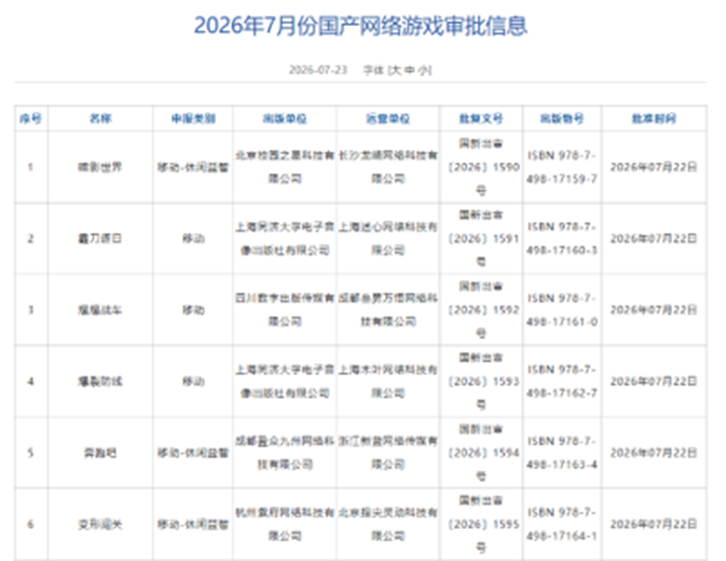
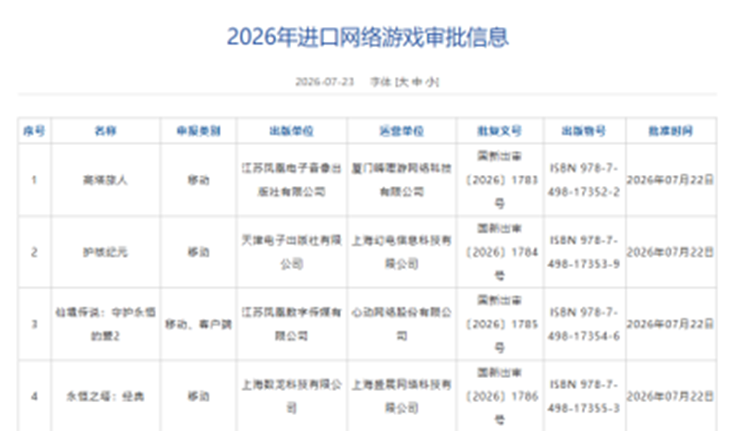
Image source: National Press and Publication Administration
Source: National Press and Publication Administration
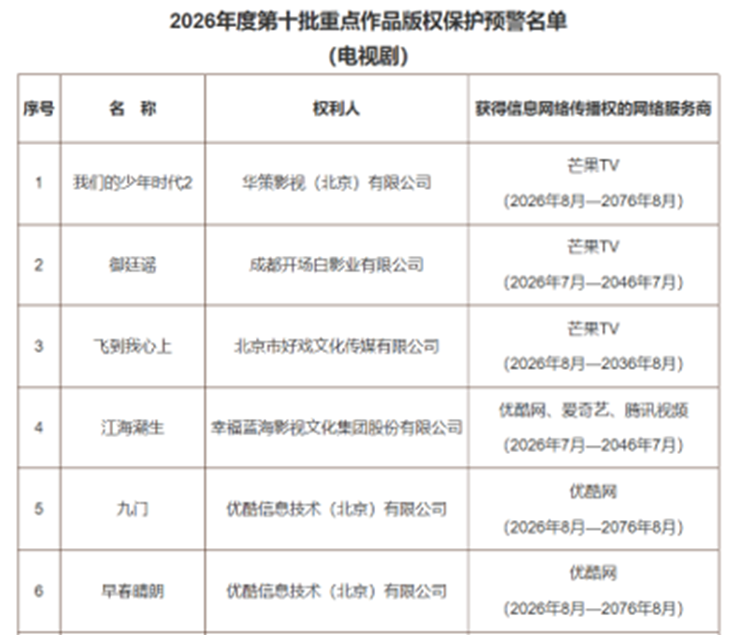
Image source: National Copyright Administration
Source: National Copyright Administration
Source: General Administration of Sport
Source: Shanghai Municipal Government Information Office
Source: CNR.cn
Source: Sina Finance
Source: Beijing Daily