
Key Focus
- The Supreme People’s Court issued the Opinions on the Lawful Trial of Disputes Involving Artificial Intelligence — clarifying adjudication rules on intellectual property infringement by AI-generated content, protection of personality rights, and liability determination for “AI hallucinations”; where, without consent, AI is used to process a natural person’s name, portrait and other information to generate a virtual digital avatar capable of identifying that natural person, and such avatar is used or made public, this constitutes an infringement of the right to name and the right to portrait.
- The National Copyright Administration issued the “15th Five-Year Plan for Copyright Work” — proposing that by 2030, the number of works registered nationwide will reach 9.5 million, the number of computer software copyright registrations will reach 4 million, the amount of copyright pledge financing registrations will reach RMB 12 billion, and promoting the improvement of supporting copyright regulations, the study and drafting of copyright rules for generative artificial intelligence, and the establishment of a reasonable use regime for AI training data.
- The Guangzhou Intellectual Property Court concluded two copyright infringement cases involving online song-on-demand services — users may enter voice chat rooms at self-selected times and locations and select songs from preset playlists; even if they need to wait in a “queue for the microphone” or the order of song requests may be adjusted, the relevant works are still in a state of being available on demand and therefore constitute interactive communication to the public; the platform’s provision of the relevant musical works without authorization constitutes an infringement of the right of communication through information networks.
The Wuxi Intermediate People’s Court of Jiangsu Province released a typical unfair competition case involving “malicious user diversion” in online games — after the judgment in the prior case took effect, the defendant continued, through affiliated companies, to organize “paid posters” to publish diversion information in three online games, inducing players to switch to its affiliated platform, which constitutes malicious repeated infringement; the court ordered the two defendants to be jointly and severally liable for compensation for economic losses and reasonable expenses totaling RMB 4.1 million. - The first nationwide intellectual property registration of a fully virtual human audio data product was completed — the certificate may serve as preliminary evidence of the data property rights enjoyed by the registrant and the legality of data collection and sources, helping to address risks such as unauthorized cloning or commercial use of virtual human voices.
News
- The Network Audiovisual Department of the National Radio and Television Administration issued the “Management Reminder on User-Uploaded Micro-Short Dramas”: short drama broadcasting platforms shall perform content management duties for micro-short dramas uploaded by institutional and individual users, and strictly implement the system of “no broadcast without prior review”; Category I and Category II micro-short dramas shall obtain a Micro-Short Drama Distribution License or approval documents, and platforms shall not disseminate self-produced micro-short dramas with special themes uploaded by individual users.
- The Beijing Copyright Administration issued the ninth batch of copyright protection warning letters for key online film and television works in 2026: covering seven TV dramas including “Winter City Manhunt” and four micro-short dramas including “Serious Crime Squad: The Vanished Police Badge”.
- CCTV Finance: with the lowering of technological thresholds and rapid expansion of production capacity, quotations for standardized AI short drama production have fallen from RMB 5,000 per minute to several hundred yuan per minute, while quotations for customized projects can still reach RMB 10,000 to 20,000 per minute; it is expected that by 2026, the domestic market size for AI short dramas and comic dramas will exceed RMB 40 billion.
- Twenty-six listed game companies have disclosed their semi-annual reports for 2026, among which 12 companies achieved year-on-year growth in net profit attributable to the parent; performance growth is mainly driven by blockbuster products, classic IPs, overseas business and AI applications; at the same time, the industry faces risks such as reliance on blockbuster games, rising promotion costs, overseas localization, and AI computing power costs.
Cases
- Shanghai Huangpu District People’s Court: the NBA and Xiaohongshu reached a settlement through mediation conducted by the Shanghai Center of the WIPO Arbitration and Mediation Center entrusted by the court, in respect of disputes arising from unauthorized dissemination of NBA game content on the platform, and signed a long-term cooperative agreement on coordinated copyright governance, establishing governance mechanisms such as content inspection and fast-track channels for copyright protection.
- DanYang People’s Procuratorate of Jiangsu Province: a blind box platform, under the guise of selling trendy toys, provided players with cash-out channels through platform currency exchange and fictitious second-hand buyback, which in substance constituted gambling; over two years, the platform cumulatively absorbed more than RMB 76 million in player top-ups, and four platform operators and technical personnel were ultimately sentenced to fixed-term imprisonment for the crime of operating a gambling establishment.
Key Focus
The Supreme People’s Court Issued the Opinions on the Lawful Trial of Disputes Involving Artificial Intelligence
The Opinions are the first judicial adjudication rules document involving artificial intelligence issued by the Supreme People’s Court. They are divided into five parts and 24 articles, and, based on existing laws such as the Civil Code, the Copyright Law, the Personal Information Protection Law, the Cybersecurity Law, and the Civil Procedure Law, provide adjudication guidance on issues including AI-related torts, intellectual property, personality rights, consumer rights, product liability, autonomous driving, litigation procedures, and criminal liability. The core points of the Opinions relating to intellectual property protection, personality rights and “AI hallucinations” are as follows:
- Clarifying rules for determining liability for copyright infringement by AI-generated content: where AI-generated content is alleged to infringe another’s copyright, the relevant parties may not claim exemption from liability solely on the ground that the alleged infringing content was generated by artificial intelligence. The people’s court shall, in light of the characteristics of AI technology and business models, the roles played by developers, service providers and users in the content generation process, the provider of training data, the necessary measures taken by each party, and the circumstances of profit, determine the control capability, duty of care, subjective fault and degree of fault of the relevant parties, and reasonably allocate liability for infringement accordingly.
- Adjusting the burden of proof in copyright disputes involving AI-generated content: where a right holder asserts copyright infringement against AI service developers or providers, the right holder shall make a preliminary showing that the alleged infringing content was generated by the AI at issue and is substantially similar to the copyrighted work. Where developers or providers raise a non-infringement defense, they shall adduce evidence regarding facts within their control such as the sources of model training data, the training process and operating mode, and, where necessary, provide relevant scientific theoretical bases. Where an AI user knows or should know of a prior work and still uses AI to generate content substantially similar to that work, and no circumstances such as fair use that exempt liability exist, infringement shall be found.
- Regulating unfair competition acts committed through AI-generated content: where business operators use AI to generate images and text, videos or virtual avatars to engage in acts such as passing off, fabricating traffic and user praise, or conducting false advertising through AI face-swapping, thereby harming the lawful rights and interests of others, misleading consumers or disrupting market competition order, the people’s court shall, in accordance with law, find such acts to constitute unfair competition such as passing off and false advertising.
- No provisions yet on the copyrightability of AI-generated content and the use of works in model training: the Supreme People’s Court stated that there remain significant divergences on whether AI-generated content can obtain copyright protection and how to characterize the use of others’ works without permission for training AI foundation models. Accordingly, the Opinions do not yet provide rules on these two issues, and the relevant adjudication rules remain to be further explored in light of technological developments and judicial practice.
- Regulating the use of AI to “fake celebrity endorsements” in accordance with law: where AI is used to impersonate celebrities to promote goods, thereby infringing others’ lawful rights and interests and constituting fraud, the people’s court shall, in accordance with law, find the relevant parties liable for infringement; where consumers claim punitive damages, the people’s court shall support such claims in accordance with law.
- Strengthening protection of personality rights such as portrait, name, voice, reputation and privacy: where, without a natural person’s consent, AI is used to process that person’s name, portrait and other information to generate a virtual digital avatar capable of identifying that natural person, and such avatar is used or made public, this constitutes an infringement of personality rights such as the right to name and the right to portrait; where a natural person’s voice is used as training corpus without consent, and AI is used to imitate that person’s timbre, intonation and pronunciation style to generate a synthetic voice that is identifiable, this constitutes an infringement of voice rights. The Opinions also regulate acts that infringe the right to privacy, such as using AI to track and analyze publicly available personal information to obtain, disclose or make public private information, and “doxxing” and “human flesh search”, and clarify that victims who meet the conditions may apply for injunctions against personality rights infringement.
- Clarifying the boundaries of liability for “AI hallucinations” and malicious inducement to generate infringing content: where generative AI automatically generates content that infringes personality rights, and, after being notified by the right holder, the service provider fails to promptly take necessary measures such as stopping generation, the service provider shall bear liability for infringement in accordance with law. Where users maliciously induce the generation of infringing content by inputting infringing prompts and thereby cause damage, the users shall bear liability for infringement; where service providers, after receiving notice, fail to promptly stop generating the relevant content, block generation instructions or take other necessary measures, they shall also bear corresponding liability in accordance with law.
- Litigation liability may not be exempted on the grounds of “AI hallucinations” or technological neutrality: participants in litigation shall verify the evidence, pleadings and case law search reports they submit, explain their use of AI assistance, and be responsible for the authenticity and accuracy of the relevant content. Where AI is used to fabricate case facts, conduct false litigation or forge evidence, the court may, in accordance with law, dismiss the claims and impose fines or detention; where a crime is constituted, criminal liability shall be pursued in accordance with law.
In addition to the above, the Opinions also address issues such as the use, within a reasonable scope, of lawfully disclosed personal information for model training, algorithmic differential treatment, the use of AI to impersonate celebrities for commercial promotion, defects in AI products, liability for autonomous driving accidents, liability for open-source software, patent grant and confirmation of AI-related inventions and creations, performance of technology contracts and norms for data use, and require improvements to mechanisms for ascertaining technical facts, reviewing evidence, providing adjudication guidance and interdepartmental coordination.
Source: China Court Network
The National Copyright Administration Issued the “15th Five-Year Plan for Copyright Work”
The Plan proposes that by 2030, China’s copyright legal system will be more complete, the level of copyright law enforcement and supervision will be significantly enhanced, the capacity for copyright-related public services will be markedly strengthened, the effectiveness of high-quality development of the copyright industry will be further manifested, and China’s international discourse power, communication capacity and influence in the field of copyright will continue to increase. The Plan mainly covers aspects such as improving the copyright legal system, building a copyright protection ecosystem, strengthening copyright service mechanisms, deepening international copyright cooperation, fostering a social environment that respects copyright, and enhancing organizational safeguards.
The core points of the Plan are as follows:
- Clarifying copyright development indicators for 2030: the Plan proposes that by 2030, the number of works registered nationwide will reach 9.5 million, the number of computer software copyright registrations nationwide will reach 4 million, the amount of copyright pledge financing registrations will reach RMB 12 billion, the added value of the copyright industry will account for 7.53% of GDP, and the added value of core copyright industries will account for 4.79% of GDP.
- Improving the system of copyright laws and regulations: the Plan proposes promoting the revision of supporting administrative regulations such as the Regulations for the Implementation of the Copyright Law, the Regulations on Collective Management of Copyright, the Regulations on the Protection of the Right of Communication through Information Networks, and the Regulations on the Protection of Computer Software, as well as departmental rules such as the Measures for the Implementation of Administrative Penalties for Copyright, the Provisional Measures for Voluntary Registration of Works, and the Measures for Registration of Computer Software Copyright. At the same time, the Plan will improve copyright protection regimes in fields such as online literature, online games, online audiovisual works, basic software and industrial software.
- Studying and establishing AI-related copyright rules: the Plan proposes studying and improving copyright rules adapted to the development of blockchain, big data and artificial intelligence, promoting the establishment of a reasonable use regime for AI training data, and studying and drafting copyright rules for generative artificial intelligence. In terms of law enforcement and governance, the Plan will regulate copyright order in fields related to generative AI, promote the resolution of AI-related copyright compliance issues, and give play to the role of collective management organizations in licensing works for AI training data corpora.
- Strengthening copyright law enforcement and protection in key areas: the Plan requires intensifying administrative copyright law enforcement, focusing on the investigation and handling of major and significant cases, strengthening special governance in key industries and fields, and imposing copyright governance responsibilities on key websites and platforms. Relevant departments will continue to carry out special campaigns such as “Sword Net” against online infringement and piracy, “Sword Shadow” for cinema film copyright protection, and the Youth Copyright Protection Season, with a focus on strengthening copyright protection for books and publications, radio and television, online audiovisual works, online literature, online games, online music, teaching materials and auxiliary publications, cinema films, major sports events and cultural and creative products, and punishing malicious rights assertion and false rights assertion in accordance with law.
- Building a unified national copyright registration and service system: the Plan proposes unifying standards, procedures and agency conduct for copyright registration, studying the establishment of a national copyright registration information service platform, and using technologies such as blockchain, big data and artificial intelligence to enhance the digitalization level of registration, promoting integrated services for copyright registration, inquiry, monitoring and statistics. In addition, the Plan encourages copyright registration for data that constitute works and promotes pilot applications of blockchain in the registration of digital works copyright.
- Promoting copyright commercialization and financial service innovation: the Plan proposes improving the construction of copyright trading centers, copyright trade bases and innovation and development bases, supporting market entities in jointly building digital platforms for copyright trading, and promoting pilot experiences in “blockchain + copyright” applications. At the same time, the Plan will optimize copyright pledge financing services, comprehensively promote online processing of pledge registration, explore innovative products and services such as copyright insurance and copyright securitization, and focus on resolving issues such as copyright value assessment, risk compensation and disposal of pledged rights.
- Improving collective copyright management and diversified dispute resolution mechanisms: the Plan proposes studying the establishment of fee adjudication mechanisms and extended collective management mechanisms for collective copyright management organizations, promoting innovation in licensing models by collective management organizations, implementing statutory licenses and carrying out international cooperation. At the same time, the Plan will deepen “overall-to-overall” online linkage between litigation and mediation for copyright disputes, develop copyright mediation organizations and expert teams, and strengthen case consultation, information sharing and clue transfer between administrative law enforcement and criminal justice.
- Strengthening software legalization and international copyright cooperation: the Plan requires continuously consolidating achievements in software legalization in government agencies, state-owned enterprises and financial institutions, promoting software legalization in key industries such as education and health, and supporting software enterprises in defending their rights overseas; deeply participating in multilateral mechanisms such as the World Intellectual Property Organization and the World Trade Organization, deepening copyright cooperation with countries and regions participating in the Belt and Road Initiative, compiling guides to the copyright business environment in key countries and regions, and improving mechanisms for responding to and preventing risks in overseas copyright disputes.
Source: National Copyright Administration
The Guangzhou Intellectual Property Court Concluded Two Copyright Infringement Cases Involving Online Song-on-Demand Services
The plaintiff, Beijing Qian某 Company, enjoys the right of communication through information networks in respect of two musical album works. The defendant, Guangzhou Huan某 Company, operates a mobile application providing online singing functions, under which registered users may set up virtual voice chat rooms and preset playlists, and other users may enter the rooms, select songs from the playlists and send virtual gifts to the room owners. Beijing Qian某 Company contended that this function provides the public with search and online playback services for the musical works at issue, constituting interactive communication to the public, and therefore filed two separate actions, requesting that Guangzhou Huan某 Company be ordered to cease infringement and compensate for economic losses and reasonable expenses. Guangzhou Huan某 Company argued that voice chat rooms are of the same nature as online live streaming rooms, that the relevant communication constitutes non-interactive communication and should be governed by the right of broadcasting, and that it had paid remuneration through relevant entities and collective copyright management organizations and should not bear liability for infringement.
The court of first instance found that the acts of Guangzhou Huan某 Company infringed the right of communication through information networks enjoyed by Beijing Qian某 Company in respect of the works at issue, and ordered it to compensate RMB 20,000 in economic losses and reasonable expenses in each case. Dissatisfied, Guangzhou Huan某 Company appealed. The Guangzhou Intellectual Property Court on second instance pointed out that the core characteristic of the right of communication through information networks lies in the public’s ability to obtain works on demand at times and places of their choosing, whereas the right of broadcasting primarily governs one-way, non-interactive communication in which the public cannot independently choose the specific content and time of playback. So long as works are placed in a network environment open to the public, enabling the public to browse, watch, listen to or download them online at times and places of their own choosing, this constitutes communication through information networks.
The Guangzhou Intellectual Property Court further held that non-specific members of the public may register and log in to the platform at issue at any time, set up or enter voice chat rooms at times and places of their own choosing, and select songs from playlists preset by room owners. Although users need to wait in a “queue for the microphone” and the order of song requests may be adjusted, the relevant works remain in a state in which users may request them on demand, exhibiting interactive communication characteristics whereby “when to listen”, “where to listen” and “which song to listen to” are all chosen by users, which is essentially different from non-interactive communication in which the public cannot intervene in the content and time of playback. Accordingly, Guangzhou Huan某 Company’s provision of the musical works at issue through the platform without authorization constitutes an infringement of the right of communication through information networks enjoyed by Beijing Qian某 Company. On this basis, the Guangzhou Intellectual Property Court found that the grounds of appeal were unfounded and upheld the first-instance findings on liability for infringement and compensation.
Source: Guangzhou Intellectual Property Court
The Wuxi Intermediate People’s Court of Jiangsu Province Concluded an Unfair Competition Case Involving “Malicious User Diversion” in Online Games
The plaintiff, Huan某 Company, exclusively operates three online games, “Mengzhong Hero”, “Medusa Legend” and “Legendary Prosperity”, under authorization from the copyright owner. Previously, the plaintiff had brought an action against Hainan Shun某 Company for organizing “paid posters” on its gaming platform to publish diversion information and induce players to switch to other gaming platforms. The effective judgment in that prior case found that such conduct violated the principle of good faith and business ethics, constituted unfair competition, and ordered Hainan Shun某 Company to cease infringement and compensate economic losses and reasonable expenses totaling RMB 2.03 million. After the prior judgment took effect, the plaintiff discovered that “paid posters” were still publishing diversion information in the games at issue, directing players to affiliated platforms of Hainan Shun某 Company, and therefore filed another action.
Upon trial, the Wuxi Intermediate People’s Court held that although the relevant platform was actually controlled by Chengdu Shun某 Company and responsible for collecting payments, its website content and operating model were highly similar to those of Hainan Shun某 Company, and the two companies, through division of labor and cooperation, in substance continued the unfair competition acts involved in the prior case, thereby constituting joint infringement. Hainan Shun某 Company’s continuation of similar conduct after the effective judgment in the prior case constituted malicious repeated infringement, with obvious subjective fault.
Given that the two defendants organized player diversion in the three online games on a large scale, and clearly intended to continue infringement and evade liability through affiliated entities, the Wuxi Intermediate People’s Court, in determining the amount of compensation, lawfully reflected punitive factors, fully supporting the plaintiff’s claim for compensation and ordering the two defendants to be jointly and severally liable for RMB 4 million in economic losses and RMB 100,000 in reasonable expenses, totaling RMB 4.1 million. No party appealed the first-instance judgment, which has now taken effect.
Source: Wuxi Intermediate People’s Court
The First Nationwide Intellectual Property Registration of a Fully Virtual Human Audio Data Product: “Luo Tianyi Audio Dataset” Obtained the Shanghai Data Product Intellectual Property Registration Certificate
The “Luo Tianyi Audio Dataset” of virtual singer Luo Tianyi under Shanghai Bilibili Technology Co., Ltd. (Bilibili) has obtained the Shanghai Data Product Intellectual Property Registration Certificate. The dataset is formed by collecting, annotating and calibrating data of Luo Tianyi’s signature timbre, and is the first fully virtual human audio data product nationwide to complete intellectual property registration. In view of the long-standing risks of unauthorized cloning and commercial use of virtual human voices, this registration aims to provide a rights basis and evidentiary support for Bilibili’s protection and utilization of the relevant virtual human audio data assets.
The “Luo Tianyi Audio Dataset” is a data collection formed through substantive processing and has been found to meet the registration requirements regarding substantive processing and innovative labor under the Provisional Measures of Shanghai Municipality on Data Product Intellectual Property Registration and Depository. According to relevant judicial practice, a data product intellectual property registration certificate may serve as preliminary evidence of the data property rights enjoyed by the registrant and the legality of data collection or sources. Therefore, this registration will assist Bilibili, in the event of disputes over unauthorized cloning, use or commercial development of the relevant timbre data, in proving data sources, processing procedures and related property rights, although the specific attribution of rights and liability for infringement shall still be determined in accordance with law based on the facts and evidence of individual cases.
Bilibili stated that it plans subsequently to apply for data product intellectual property registration for more granular “speech corpus unit libraries” of Luo Tianyi, and to gradually improve the protection system for virtual human audio data assets through layered registration. The Yangpu District service window for data product intellectual property in Shanghai provides enterprises with guidance on registration examination issues such as substantive processing and innovative labor, and assists in connecting them to fast-track examination channels; the Yangpu District People’s Procuratorate also provides relevant legal safeguards through on-site services. This case provides practical reference for the registration, compliant use and subsequent rights protection of virtual human timbre, speech corpora and other digital assets.
Source: China Intellectual Property News
News
Source: Broadcasting & Television Sector
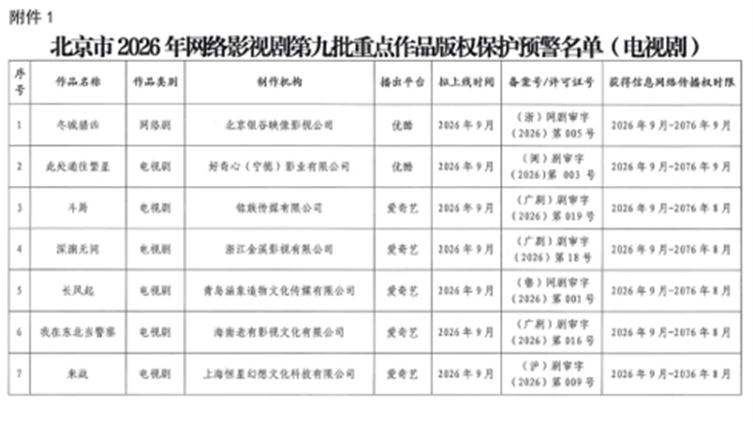
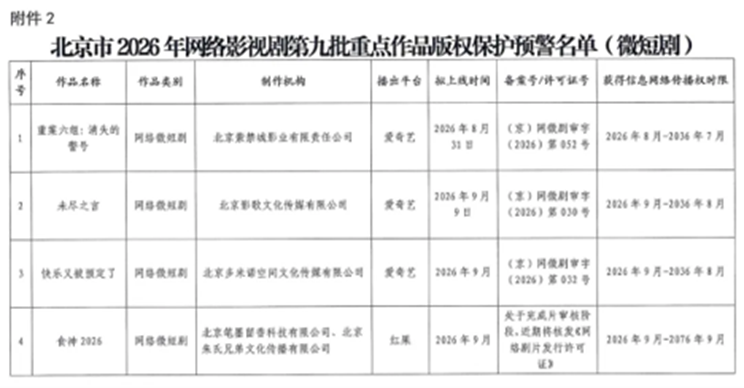
Image source: Beijing Copyright Administration
Source: Beijing Copyright Administration
Source: CLS
Source: Beijing Business Today
Cases
Source: Shanghai High People’s Court
Source: Procuratorial Daily