

This article focuses on key issues concerning punitive damages in intellectual property, providing an in-depth analysis of the constituent elements of liability for punitive damages and the rules for calculating the amount of damages. Through a detailed analysis of typical cases in recent years, it summarizes the specific factors considered by the courts when determining the elements of “intent” and “serious circumstances,” and sets out in detail the methods for determining the calculation base, the applicable multipliers, and the method for calculating the final total amount of damages, with a view to providing right holders with practical guidance and reference.
On this basis, we have selected the following three popular Q&A items from Chapter 10: Punitive Damages for Intellectual Property Infringement of the Practical Q&A Handbook on Cutting-edge Issues in Intellectual Property, jointly compiled by Wolters Kluwer, Lusheng Law Firm and its strategic partner Rouse International, to share with you.
Selected Practical Q&A
Q1
[Proof of the “intent” element in punitive damages] How can a right holder prove that the infringer “intentionally” infringed its intellectual property rights?
As to the distinction between “intent” and “malice,” the Trademark Law and the Anti-Unfair Competition Law use the term “malice,” whereas the Civil Code, the Patent Law and the Copyright Law use the term “intent.” In this regard, Article 1, paragraph 2 of the Interpretation on the Application of Punitive Damages in the Trial of Civil Cases of Intellectual Property Infringement[1] (the “Punitive Damages Interpretation”) expressly provides that “intent” includes “malice” as stipulated in the Trademark Law and the Anti-Unfair Competition Law.
In addition, Article 3 of the Punitive Damages Interpretation[2] sets out the criteria for determining “intent,” namely that the determination of “intent” shall be made by comprehensively considering such factors as the type of the infringed intellectual property object, the status of the right and the reputation of the relevant products, as well as the relationship between the infringer and the right holder. This article enumerates in detail the circumstances in which the infringer’s intent to infringe may be preliminarily established. In light of practical case experience, the right holder may collect evidence of “intent” from the following perspectives:
The first circumstance is where the infringer continues the infringement after the right holder has actively performed its obligation to issue an infringement notice/warning. This mainly includes situations where, after the right holder, its entrusted agent or the competent administrative authority for intellectual property has issued an infringement notice/warning to the infringer, the infringer still continues to commit the infringing acts.
It should be noted that the notice/warning issued by the right holder must be a valid notice/warning. A valid notice/warning shall contain the following key points: (1) the notice/warning identifies the true identity information of the right holder; (2) the notice/warning contains preliminary evidence that the alleged acts constitute infringement, and its content shall enable the infringer to make a reasonable judgment as to whether its acts constitute infringement; and (3) regardless of whether the notice/warning is sent by letter, fax, email or other means, it shall be effectively served on the infringer. It is advisable for the right holder to preserve evidence of effective service with a timestamp.
The second circumstance is where, due to contractual, cooperative or other relationships between the infringer and the right holder, the infringer has become aware of the right holder’s intellectual property. Typical conduct includes: (1) the infringer continues to use the originally licensed subject matter after the expiry of the licence agreement; (2) the infringer or its legal representative or manager was formerly the legal representative, manager or de facto controller of the right holder, where “manager” includes senior management personnel as well as ordinary management personnel who are able to access the infringed intellectual property; (3) there exists an employment, service, cooperation, licence, distribution, agency, representation or other relationship between the infringer and the right holder, and the infringer has had access to the infringed intellectual property; (4) there are business dealings between the infringer and the right holder, or negotiations have been conducted for the conclusion of a contract or the like, and the infringer has had access to the infringed intellectual property.
The third circumstance is where the infringer continues to commit infringing acts after having become aware of the right holder’s intellectual property rights in judicial, administrative, arbitral or other proceedings. Typical conduct includes: (1) the infringer, having become aware of the right holder’s trademark rights in trademark authorisation and confirmation proceedings, still commits acts infringing such trademark rights; (2) the infringer continues to exploit or use the intellectual property after the wrongfully obtained intellectual property right has been revoked or declared invalid in accordance with the law; (3) the infringer, having previously been held liable for infringement by administrative penalties, court judgments, arbitral awards, or having reached a settlement or mediation with the right holder, again commits the same or similar infringing acts.
The fourth circumstance is where the infringer engages in piracy or counterfeiting of intellectual property. In such circumstances, the infringer has committed clearly targeted infringing acts against the right holder’s intellectual property, and the infringer’s subjective state may be directly determined as having knowledge and actively pursuing the infringing result. In this regard, the right holder may adduce evidence from aspects such as product quality, anti-counterfeiting marks, detailed design, sales price and sales methods to prove that the accused infringing products are pirated or counterfeit products and that the infringer had intent to infringe, for example, by covering or removing the right holder’s marks when promoting or providing infringing goods or services.
The fifth circumstance is where the infringement involves well-known trademarks, well-known audiovisual works or other intellectual property with a high degree of reputation. This includes using the right holder’s registered well-known trademark on identical or similar goods, maliciously pre-emptively registering and using the right holder’s well-known trademark, etc. The right holder may prove that its intellectual property enjoys a high degree of reputation, thereby presuming that operators in the same region and industry ought to be aware of it and bear a higher duty of avoidance and care, and further presuming that the infringer had subjective intent.
Q2
[Proof of the “serious circumstances” element in punitive damages] How can a right holder prove that the infringer’s infringing acts constitute “serious circumstances”?
Article 4 of the Punitive Damages Interpretation[3] sets out the criteria for determining “serious circumstances,” namely that the determination of “serious circumstances” shall be made by comprehensively considering such factors as the means and frequency of infringement, the duration, geographical scope and scale of the infringing acts, the consequences of the infringement, and the infringer’s conduct in civil litigation and other proceedings. This article enumerates in detail the circumstances that may be determined as constituting serious circumstances. In light of practical case experience, the right holder may adduce evidence on the element of serious circumstances around the following aspects:
1. Factors relating to the means, methods and frequency of infringement
Typical conduct includes: (1) the infringer, after having been found to have committed infringement by an administrative penalty or administrative decision, again commits the same or similar infringing acts; (2) the infringer, after having been found to have committed infringement by an effective judgment, mediation statement or arbitral award, again commits the same or similar infringing acts; (3) the infringer, after having acknowledged infringement in a settlement agreement voluntarily reached with the right holder, again commits the same or similar infringing acts; (4) the infringer, by setting up additional enterprises, changing enterprise names, changing legal representatives, using affiliated enterprises and other means, again or continuously commits the same infringing acts; (5) the infringing methods are multi-channel and multi-type.
2. Factors relating to the scale, duration and geographical scope of infringement
Typical conduct includes: (1) the infringer is engaged in the business of infringing intellectual property as its trade, and the right holder may adduce evidence to prove that the infringing acts constitute its principal business or main source of profit. It should be noted that the principal business shall not be determined based on the business scope registered on the infringer’s business licence, but rather by focusing on its actual business operations; (2) the scale of infringing production or sales is large, the duration of the infringing acts is long, and the geographical scope involved is broad; (3) the amount of profits obtained from the infringement is enormous.
3. Factors relating to the consequences of infringement
Typical conduct includes: (1) the quantity of products sold is huge, causing significant damage to the right holder’s market share, commercial value and business reputation; (2) while lawfully providing goods or services under licence, the infringer also provides, without authorisation, goods or services that infringe the same intellectual property, commonly known as “mixing genuine and counterfeit goods”; (3) the infringer’s acts result in the trade secrets becoming known to the public; (4) the infringer disseminates infringing works without authorisation before or at an early stage of the public dissemination of the right holder’s works; (5) the infringing acts may endanger national security, public interests or personal health, for example where the infringing products involve the food or pharmaceutical sectors.
4. Factors relating to the infringer’s conduct in infringement litigation and administrative enforcement
Typical conduct includes: (1) the infringer forges, destroys or conceals evidence of infringement, which includes evidence as to whether infringement is constituted as well as evidence capable of proving the consequences of the infringement; (2) the infringer uses violence, coercion or other illegal or improper means to obstruct state officials from conducting investigations and collecting evidence in accordance with the law; (3) the infringer refuses to comply with preservation rulings, including conduct preservation and evidence preservation; (4) the infringer refuses to comply with effective judgments, rulings, awards and the like that have determined infringement.
Q3
[Punitive considerations in statutory damages] May punitive damages factors be taken into account in statutory damages or discretionary damages?
The threshold for the application of punitive damages is relatively high. In addition to proving “subjective intent” and “serious circumstances,” it is also necessary to provide evidence proving a clear base amount for punitive damages. In practice, it is often difficult to ascertain the right holder’s losses and the defendant’s profits, and the obtainable licence fees are often not entirely consistent with the type of infringing acts, which in turn makes it difficult for the right holder to accurately calculate and claim the base amount for punitive damages, and thus difficult for the court to apply punitive damages.
For cases in which the base amount for calculating punitive damages cannot be determined as described above, or cases in which the right holder has not requested punitive damages, where the infringer has obvious intent to infringe and the circumstances are serious, the right holder may still roughly calculate an amount by reference to the above methods for calculating the base amount of damages, and request the court to take such amount and punitive factors into account as circumstances for determining discretionary damages, thereby determining a total amount of damages higher than such amount. If the calculation result exceeds the upper limit of statutory damages and the evidence is sufficient, the court may determine the amount of damages above the upper limit of statutory damages. For example, in the trademark infringement dispute between Guangdong Yongquan Valve Technology Co., Ltd., Yongquan Valve Co., Ltd. et al. and others[4], the Guangdong High People’s Court held that where the infringer has obvious subjective malice and the infringing acts are of a serious nature, but punitive damages cannot be applied due to reasons such as the right holder’s failure to expressly claim punitive damages or the inability to determine the base amount for calculating damages, the infringer’s intent and the circumstances of the infringing acts may be taken as punitive considerations, and heavier damages may be awarded within the scope of statutory damages, up to the statutory maximum. The court ultimately ordered the infringers to pay a total of RMB 10 million in compensation for economic losses and reasonable enforcement expenses.
It is worth noting that, although the base amount for calculating punitive damages is often difficult to determine precisely, in some cases the courts have not imposed overly stringent requirements on the accuracy of the calculation of the base amount. On the basis that some of the data required for calculating damages is supported by evidence, the courts have exercised their discretion, in light of the circumstances of the case, to determine other data required for calculating damages, to determine a fair and reasonable base amount, and have applied punitive damages, thereby reducing the difficulty for right holders in enforcing their rights. A typical case is the dispute over infringement of new plant variety rights between a certain seed technology company in Liaoning and a certain seed technology company in Linghai and a certain agricultural technology company in Qingdao[5], in which the Supreme People’s Court reversed the first-instance judgment that had rejected the Liaoning seed technology company’s claim for punitive damages on the ground that the base amount for calculating damages could not be determined, and instead fully upheld the company’s claim for RMB 3 million in damages. This case makes it clear that the base amount for punitive damages may be determined by discretion based on the evidence on file, and that courts may not simply resort to statutory damages on the ground that precise calculation is difficult.
In addition, where the full amount of the base serving as the basis for punitive damages cannot be ascertained, some courts have not directly refused to apply punitive damages on that ground, but have instead coordinated the application of different methods of calculating damages within the same case: where part of the plaintiff’s actual losses and the defendant’s profits from infringement can be ascertained and the remaining part cannot, punitive damages may be applied to the ascertained part as the base amount, while statutory damages may be separately applied to the remaining part. A typical case is the trademark infringement dispute between Zhejiang Jukai Sewing Technology Co., Ltd. and JUKI Corporation[6] heard by the People’s Court of Pudong New Area, Shanghai, in which the court held that, since punitive damages may be applied where the full amount of the base is ascertained, then, a fortiori, where part of the amount can be determined, punitive damages may also be applied to that part. The Shanghai Intellectual Property Court upheld this approach on appeal.
Appendix:
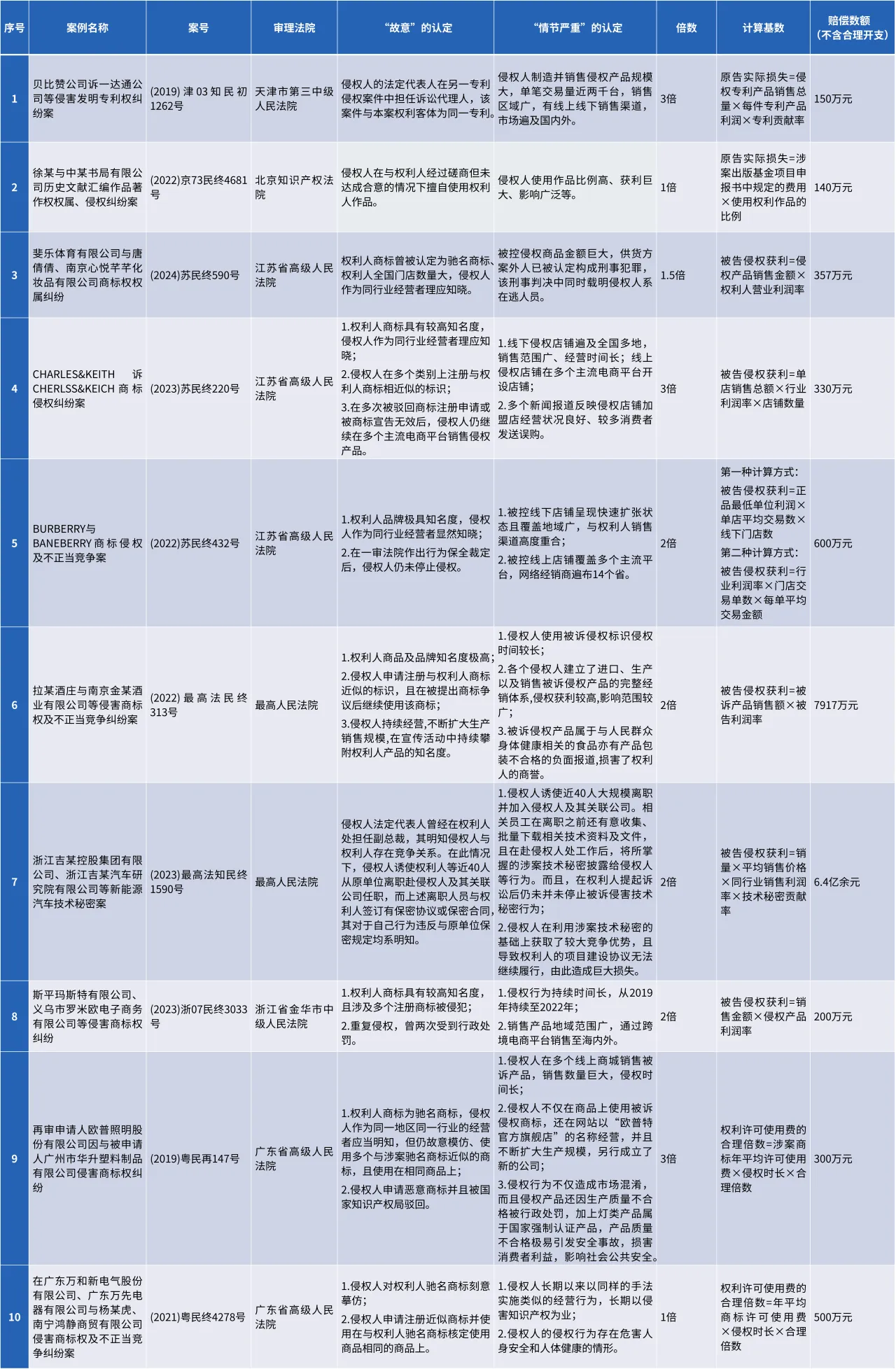
In light of the above issues, we have sorted out typical cases of punitive damages for intellectual property infringement in recent years, summarized the factors considered by the courts when determining the elements of “intent” and “serious circumstances,” and listed the methods for determining the calculation base, the multipliers and the final total amount of damages:
Other excellent Q&A covered in this chapter:
-
[Circumstances for the application of punitive damages] Under what circumstances may a right holder claim the application of punitive damages?
-
[Time limit for claiming punitive damages] In civil litigation, by when at the latest should a right holder raise a claim for punitive damages?
-
[Calculation of the amount of punitive damages] After punitive damages are applied, how is the total amount of damages calculated?
-
[Determination of the base amount for calculating punitive damages (I)] How is the basic amount of damages, i.e. the calculation base, for punitive damages determined?
-
[Determination of the base amount for calculating punitive damages (II)] What other factors are considered in determining the base amount for calculating punitive damages?
-
[Determination of the multiplier for punitive damages] How should the multiplier for punitive damages be claimed and determined, and how can right holders increase the multiplier for punitive damages?
Authors of this chapter
Yu Yisi Head of Shanghai Litigation Team
Lusheng Law Firm Shanghai
Email: ayu2@lushenglawyers.com
Yin Jianmei Lawyer
Lusheng Law Firm Shanghai
Email: myin@lushenglawyers.com
Cheng Chen Paralegal
Lusheng Law Firm Shanghai
Email: echeng@lushenglawyers.com
Request the Report
To unlock all Q&A content in this chapter as well as the full content of the Practical Q&A Handbook on Cutting-edge Issues in Intellectual Property, you are welcome to click this link to request the full version of the handbook. We will send it to you by email within 3–7 working days.
*This material is only sent to corporate personnel. Thank you for your understanding.

About the report:
The Practical Q&A Handbook on Cutting-edge Issues in Intellectual Property was jointly and meticulously prepared by Wolters Kluwer, Lusheng Law Firm and its strategic partner Rouse International, and was officially released online in November 2024. The handbook was compiled by more than 30 senior intellectual property experts, and selects 108 intellectual property questions divided into 11 chapters, comprising a total of 100,000 words of detailed analysis. It focuses on the most cutting-edge issues currently of concern in the industry, comprehensively covering key areas such as patents, trademarks, copyright, trade secrets, unfair competition on the internet, intellectual property capital contribution and punitive damages for intellectual property infringement. In a “question-and-answer” format, it distils the hot topics of concern to intellectual property practitioners and provides readers with the latest legal interpretations, case analyses and practical guidance.
Since its release, the report has attracted wide attention and high praise in the industry. In order to better share its excellent content, we will continue to select key Q&A items from each chapter and publish them in a series of articles.