
Recently, the Shanghai No. 3 Intermediate People’s Court (Shanghai Intellectual Property Court, Shanghai Railway Transport Intermediate Court) released the Ten-Year Typical Judicial Cases on Intellectual Property. The cases “Tesla (Shanghai) Co., Ltd. v. Zhongyin Food Co., Ltd., Guangdong Zhongyin Food Co., Ltd., Tangjiu Network Technology (Shanghai) Co., Ltd. on Trademark Infringement and Unfair Competition” and “Babyzen Company v. Hebei Lvyuan Children’s Vehicle Co., Ltd. on Dispute over Invention Patent Infringement”, in which Lusheng Law Firm acted as counsel, were honorably selected.
01
Tesla (Shanghai) Co., Ltd. v. Zhongyin Food Co., Ltd., Guangdong Zhongyin Food Co., Ltd., Tangjiu Network Technology (Shanghai) Co., Ltd. on Trademark Infringement and Unfair Competition
— Copying and imitating another party’s registered well-known trademark constitutes infringement
Brief Facts of the Case
Tesla discovered that Zhongyin Company and Guangdong Zhongyin Company displayed, sold and promoted soda alcoholic beverages and beer infringing Tesla’s exclusive right to use its registered trademarks at the Jinan Autumn Sugar and Wine Fair in 2020 and the Chengdu Spring Sugar and Wine Fair in 2021. Upon further investigation, Tesla also found that Zhongyin Company and Guangdong Zhongyin Company sold infringing products online through Taobao and Pinduoduo, and offline through nightclubs, bars, experience stores and convenience stores, and further promoted the infringing products on WeChat official accounts, investment promotion websites (such as Huobao Food and Beverage Investment Promotion Network, Huobao Good Wine Investment Promotion Network, Tangjiu Network), Douyin accounts, Weishi accounts, Tencent, Youku and other platforms, using promotional phrases such as “planned by International Top Brand Co., Ltd., international positioning standards”. The conduct of Zhongyin Company and Guangdong Zhongyin Company had in fact caused confusion among consumers and resulted in serious adverse impact on Tesla. Tesla therefore brought a lawsuit against Zhongyin Company and Guangdong Zhongyin Company before the court.
After proceedings on jurisdictional objection, first instance and second instance, the case was finally concluded by a final judgment rendered by the Shanghai High People’s Court, which dismissed the appeal and upheld the original judgment, namely: (1) Zhongyin Company and Guangdong Zhongyin Company shall immediately cease their trademark infringement acts; (2) Zhongyin Company and Guangdong Zhongyin Company shall immediately cease their acts of unfair competition by false advertising; (3) Zhongyin Company and Guangdong Zhongyin Company shall, within thirty days from the effective date of the judgment, publish a statement in Legal Daily to eliminate the impact caused to Tesla by their infringing acts; (4) Zhongyin Company and Guangdong Zhongyin Company shall, within ten days from the effective date of the judgment, compensate Tesla for economic losses and reasonable expenses in a total amount of RMB 5 million.
Typical Significance
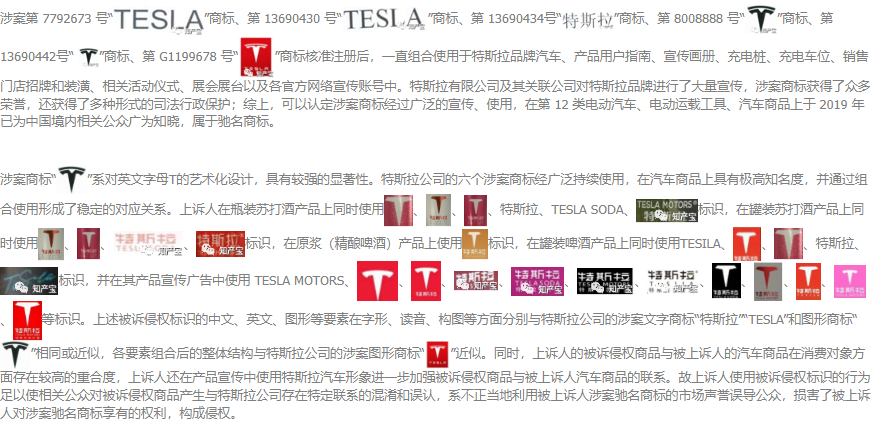
This case has also been selected as an “Outstanding Transaction in Business Law 2023 (Intellectual Property Category)”.
Read More
Read the judgment in this case
Obtain the detailed courseware on this case through the article
Lusheng Insights | Detailed Analysis of Tesla v. “Tesla Beer” Case
02
Babyzen Company v. Hebei Lvyuan Children’s Vehicle Co., Ltd. on Dispute over Invention Patent Infringement
— The right holder may lawfully choose the method of calculating damages that is most favorable to the protection of its rights
Brief Facts of the Case
Babyzen Co., Ltd. (“Babyzen”) is a globally renowned children’s stroller company. Its “Babyzen yoyo” stroller is innovative and, based on its globally pioneering one-button folding patent, makes folding and unfolding the stroller effortless and no longer cumbersome; the “Babyzen yoyo” stroller has therefore become a household name among young parents.
However, while the “yoyo” stroller was selling briskly, Hebei Lvyuan Children’s Vehicle Co., Ltd. (hereinafter “Lvyuan Company”) closely followed suit by imitating the yoyo stroller and massively producing and selling counterfeit versions of the yoyo stroller to seek unlawful gains. As Lvyuan Company did not invest any research and development costs and used very ordinary materials, its products were sold at low prices and quickly eroded the plaintiff’s market through such low-price strategy, causing the plaintiff enormous losses. The plaintiff therefore filed a lawsuit with the Shanghai Intellectual Property Court, requesting that the defendant cease the infringement and compensate for the losses.
Upon trial, the court found that the technical features of the children’s strollers manufactured and sold by the defendant Lvyuan Company fell entirely within the scope of protection of the patent claims asserted by the plaintiff, thereby constituting infringement of the plaintiff’s invention patent right. In determining the amount of damages, the court in this case accepted the method of calculating damages for patent infringement based on the plaintiff’s losses, and, in conjunction with the evidence on file, appropriately applied the rules of evidence to reasonably infer the profit margin of the patented products and the contribution rate of the patent, and ultimately fully upheld the plaintiff’s claim for damages in the amount of RMB 3 million.
Typical Significance
This case is a particularly noteworthy one in which the Shanghai courts addressed the difficulty of determining damages in intellectual property cases. In this case, on the basis of meticulous technical comparison to establish the fact of infringement, the Shanghai Intellectual Property Court focused on resolving the problem of difficulty in awarding damages in intellectual property infringement cases.
In this case, since the infringing products required no investment in research and development costs, their prices were low; at the same time, the infringing products used exactly the same patented technology and could achieve the same technical effects as the patented products, enabling consumers to obtain essentially the same functional experience from the products. Therefore, the infringing products became “ideal substitutes” for the patented products and caused a tremendous impact on the market for the patented products. At present, the main methods of calculating damages for patent infringement in judicial practice are: the plaintiff’s losses, the defendant’s profits, and statutory damages. Among these methods, the plaintiff’s losses are closest to the essence of damages for infringement. In this case, Babyzen’s counsel submitted a large amount of evidence to demonstrate the magnitude of the “gap” in the right holder’s losses caused by the infringement, thereby enabling the court, in accordance with the “make-whole principle” of tort liability and the relevant provisions of judicial interpretations, to adopt the method of calculating damages based on the plaintiff’s losses as requested in this case.
This case has also been selected as one of the “Top 100 Model Cases of Shanghai Courts in 2021” and the “Typical Cases of Shanghai Courts in 2021 on Strengthening Intellectual Property Protection”.