
Key Focus
- The National Radio and Television Administration (NRTA) has launched a two‑month special campaign to regulate harmful and vulgar content and copyright infringement/piracy in micro‑short dramas — focusing on eight key issues, namely harmful content involving children, borderline soft pornography, money worship and flaunting wealth, distorted views on marriage and relationships, feudal dross, violent revenge, vulgar titles, and copyright infringement/piracy.
- The National Copyright Administration has released the report “Status of Copyright Protection and Development in China (2025)” — the total number of copyright registrations nationwide has exceeded ten million for two consecutive years; copyright authorities at all levels investigated and handled 4,170 cases of copyright infringement and piracy, shut down 2,920 infringing and pirated websites, and removed 1.16 million infringing and pirated links.
- Beijing Chaoyang District People’s Court: Nayuki Tea’s naming of a tea beverage as “Mi Bubu” and bundling it with LABUBU dolls constitutes unfair competition — even if an operator adds a disclaimer in its marketing materials, if the overall product naming, bundling arrangement and promotional context are still sufficient to cause consumers to mistakenly believe that there is a co‑branding, licensing or commercial cooperation relationship, such disclaimer can hardly exempt the operator from liability for unfair competition arising from commercial confusion.
News
- The Cyberspace Administration of China and the State Administration for Market Regulation have jointly issued the “Regulations on Online Evaluation Activities”: it is clarified that consumer information on consumption experience regarding specific products does not fall within the scope of online evaluation activities; online evaluation activities must not adopt different standards or different methods to conduct horizontal or vertical comparisons of similar products, must not enhance the reputation of evaluation samples by disparaging other products, and must not make false or inaccurate descriptions of products or maliciously denigrate them.
- The China Copyright Association convened in Beijing the “Conference on Online Copyright Protection for the 2026 FIFA World Cup in USA, Canada and Mexico”: the Fourth Branch of the Beijing Municipal People’s Procuratorate will provide “menu‑based procuratorial services” for the event; China Media Group and Xiaohongshu have established special working groups for copyright protection of the event.
- The Administrative Committee of the Beijing Economic‑Technological Development Area has publicly solicited opinions on the “Several Measures of the Beijing Economic‑Technological Development Area for Promoting High‑Quality Development of the Game and E‑sports Industry”: it is proposed to grant an online launch reward of RMB 200,000 for each original game approved for official launch and operation, and the maximum amount of subsidies related to development and operation costs for a single game after long‑term operation may reach RMB 10 million.
- The Administrative Committee of the Hengdian Film and Cultural Industry Cluster has issued the “Service Management Specifications for Filming in the Micro‑Short Drama Industry in the Hengdian Film and Cultural Industry Cluster”: this is the first service management specification for the micro‑short drama industry nationwide, requiring guidance services for micro‑short drama projects from the source and promoting a closed loop of review services; it protects the rights and interests of underage actors by establishing a filing system for participation and a digital supervision system, with early warnings issued when filming time exceeds the prescribed limit.
- The Chengdu Municipal Bureau of Culture, Radio, Television and Tourism has revised and promulgated the “Interim Measures of Chengdu for Promoting the Healthy and Orderly Development of the Script Entertainment Industry”, clarifying that, except on national statutory holidays, rest days and winter and summer vacations, script entertainment business activities must not be provided to minors; it requires scripts to indicate age‑appropriateness reminders, and scenes not suitable for minors must be prominently indicated and minors must be prohibited from entering.
- As of 8 June, the annual box office for films in 2026 has exceeded RMB 16.063 billion, with “Pegasus 3”, “A Letter to Grandma” and “The Bladesman” temporarily ranking in the top three; more than 60 films have been scheduled for release during the summer season, covering diverse genres such as historical, science fiction, youth and animation.
- According to Sensor Tower, in May 2026, a total of 38 Chinese companies were listed in the TOP 100 global mobile game publishers by revenue, with combined revenue of USD 2.29 billion, accounting for 42.8% of the revenue of the global TOP 100 mobile game publishers for the period; Tencent, Century Games, Lemon Jam, NetEase and miHoYo ranked in the top five Chinese mobile game publishers by global revenue, among which Century Games once again reached a new high in global revenue for the month.
Cases
- Zhejiang Jiaxing Nanhu District People’s Court: A nursing company sold diaper products bundled with genuine LABUBU dolls and carried out marketing activities on this basis, which simultaneously constituted copyright infringement of the LABUBU artistic works and unfair competition in the form of commercial confusion; the company was ordered to pay RMB 100,000 in damages.
- Zhejiang Quzhou Jiangshan City People’s Court: An individual e‑commerce seller’s large‑scale purchase of genuine blind boxes of a well‑known IP and their resale as “open boxes” does not constitute unfair competition, but the extensive use of promotional images of genuine products in the product links constitutes copyright infringement; the defendant was ordered to pay RMB 18,000 in damages.
- miHoYo Legal Department: A web blogger, driven by commercial interests, repeatedly released improper evaluation videos targeting games such as “Genshin Impact” and “Honkai: Star Rail”, and used insulting and extreme language to induce players to “quit the game” or “switch games”. The court held that the blogger had infringed miHoYo’s right of reputation and ordered him to compensate miHoYo for economic losses of RMB 500,000.
Key Focus
The National Radio and Television Administration Launches a Two‑Month Special Campaign to Regulate Harmful and Vulgar Content and Copyright Infringement/Piracy in Micro‑Short Dramas
This campaign focuses on rectifying eight prominent issues, namely harmful content involving children, borderline soft pornography, money worship and flaunting wealth, distorted views on marriage and relationships, feudal dross, violent revenge, vulgar titles, and copyright infringement/piracy. The campaign requires provincial‑level radio and television authorities to implement territorial regulatory responsibilities and establish mechanisms for inspections, spot checks and dynamic supervision over platforms and production institutions within their jurisdictions; relevant platforms and production institutions are also required to fulfill their primary responsibilities by proactively screening and promptly handling problematic content. Upon completion of the special campaign, the NRTA will further carry out normalized monitoring and supervision and promote the improvement of relevant laws and regulations and institutional systems.
This special campaign is a continuation of the increasingly refined regulation and governance of micro‑short drama content since the second half of 2025. In order to foster a clean and healthy ecosystem for the micro‑short drama industry, the Network Audiovisual Program Administration of the NRTA has, since the second half of 2025, continuously issued multiple management reminders, consistently strengthening regulatory requirements regarding thematic orientation, value expression, animation forms and the protection of minors.
On the basis of the special campaign and continuous management reminders, the regulation of micro‑short dramas is further moving towards institutionalization and long‑term effectiveness. At the State Council’s regular policy briefing held on 6 February 2026, the relevant official of the NRTA explicitly announced that the “Administrative Measures for the Development of Micro‑Short Dramas” will be formulated and implemented. These Measures aim to strengthen policy safeguards and, while firmly upholding the bottom line of content security, to place equal emphasis on “flexible regulation” and “effective governance”, so as to promote fair market competition and stimulate the innovative and creative vitality of the industry in the integration of “micro‑short dramas+” and new technologies such as artificial intelligence.
Source: National Radio and Television Administration
The National Copyright Administration Releases “Status of Copyright Protection and Development in China (2025)”
The “Status of Copyright Protection and Development in China (2025)” covers four aspects, namely the copyright legal system, copyright protection and regulation, copyright services and industrial development, and international exchanges and cooperation in the field of copyright. It systematically reviews China’s copyright‑related work in 2025. The key contents are as follows:
- Cracking down on infringement and piracy with strict measures, with significant achievements in administrative enforcement: The National Copyright Administration guided local authorities in investigating and handling a total of 4,170 cases of copyright infringement and piracy, shutting down 2,920 infringing and pirated websites, and removing 1.16 million infringing and pirated links; the “Sword Net 2025” special online campaign investigated and handled 1,472 online infringement cases; multiple departments jointly supervised and handled 109 major and particularly significant cases.
- The judicial system maintains high pressure against infringement: People’s courts accepted 259,248 new first‑instance civil cases involving copyright, 27 new first‑instance administrative cases, and 1,071 new first‑instance criminal cases; people’s procuratorates approved the arrest of 246 cases involving 368 persons suspected of the crime of copyright infringement and initiated public prosecutions in 894 cases involving 1,710 persons; public security organs, in special campaigns such as “Kunlun”, filed and investigated 26,000 criminal cases involving infringement of intellectual property rights and the manufacture and sale of counterfeit and substandard goods, and solved more than 1,100 criminal cases involving copyright.
- Optimization of public services and significant improvement in the quality and efficiency of copyright registration: The total number of copyright registrations nationwide reached 10.677 million, once again surpassing the ten‑million mark, including 7.4939 million registrations of works and 3.1828 million registrations of computer software copyrights. Among them, a total of 7.1241 million works in the three categories of artistic works, photographic works and written works were registered, accounting for 95.07% of all registered works.
- Steady development of the copyright industry with notable contributions to the economy and employment: The value added of China’s copyright industry reached RMB 10.06 trillion, accounting for 7.46% of the national GDP, of which the value added of the core copyright industries was RMB 6.37 trillion, accounting for 4.72% of GDP; the copyright industry absorbed a large employment scale, with 15.895 million employees in urban entities, accounting for 9.63% of the total number of employees in urban entities nationwide; foreign trade in the copyright industry remained stable with a positive trend, with exports of copyright industry goods reaching USD 421.165 billion, accounting for 11.78% of the total national goods exports.
Source: National Copyright Administration
Beijing Chaoyang District People’s Court: Nayuki Tea’s Naming of a Tea Beverage as “Mi Bubu” and Bundling It with LABUBU Dolls Constitutes Unfair Competition

Image source: Beijing Evening News
This case arose from a themed marketing campaign launched by Nayuki Tea in September 2025. Nayuki named several tea beverages “Mi Bubu” and used images and keywords related to “LABUBU” in its publicity on WeChat official accounts, mini‑programs and offline stores, while also launching promotional activities such as “Drink Mi Bubu and Draw LABUBU”. POP MART argued that Nayuki used, without authorization, signs identical or similar to “LABUBU” for commercial promotion, which was likely to cause the relevant public to mistakenly believe that there was a co‑branding, licensing or other commercial cooperation relationship between the parties, thereby constituting unfair competition.
The Beijing Chaoyang District People’s Court held that although Nayuki Tea indicated in small print on the display boards that “the prizes for this event are independently purchased by Nayuki and there is no official cooperation with POP MART”, the font size of this statement was small and it was located at the bottom of the promotional graphics and text, and compared with the larger‑font promotional phrases such as “Drink Mi Bubu and Draw LABUBU” located at the center of the promotional graphics and text, it was insufficient to alert consumers that its tea products were unrelated to POP MART. Ultimately, the Beijing Chaoyang District People’s Court found that Nayuki Tea had engaged in unfair competition in the form of commercial confusion and ordered it to compensate POP MART for economic losses of RMB 300,000 and reasonable rights‑protection expenses of RMB 20,000.
This case clarifies that even if an operator purchases genuine products through lawful channels as promotional gifts, it must not, by prominently using another’s well‑known IP name, similar signs, visual images or marketing language, attract traffic to its own products and create a false impression of co‑branding, licensing or commercial cooperation. For cross‑sector marketing scenarios such as designer toys, tea beverages, cultural tourism and retail, whether there is a formal licensing or cooperation relationship should be clearly and prominently presented in the overall promotional design, and “small‑print disclaimers” cannot serve as a tool to evade liability for confusion.
Source: Beijing Evening News
News
Source: Cyberspace China
Source: China Copyright Association
Source: Beijing Municipal People’s Government
Source: Jinhua Daily
Source: Sichuan News
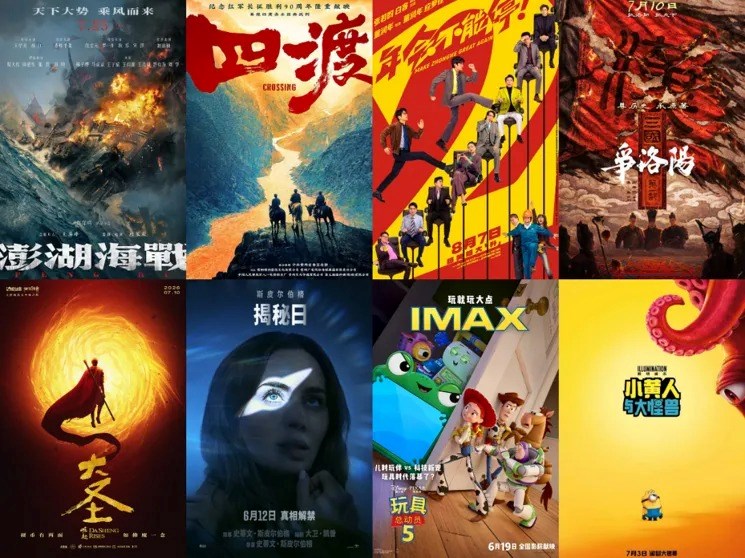
As of 8 June, the annual box office for films in 2026 has exceeded RMB 16.063 billion, with “Pegasus 3”, “A Letter to Grandma” and “The Bladesman” temporarily ranking in the top three; more than 60 films have been scheduled for release during the summer season, covering diverse genres such as historical, science fiction, youth and animation.
Source: The Paper, Beijing News
Source: Sensor Tower
Cases
Source: People’s Court Daily
Source: People’s Court Daily
Source: miHoYo Legal Department