

Against the backdrop of the rapid development of artificial intelligence technologies and major changes in the global landscape, the academic symposium “The Age of Artificial Intelligence: Opportunities and Challenges for Intellectual Property,” organized by the Intellectual Property Law Research Center of Tsinghua University School of Law, was successfully held on 26 November 2024 at the Liao Kaiyuan Building of Tsinghua University.
Jiang Nandi, Managing Partner of Lusheng Law Firm, and Su Yanhong, Head of Digital and Commercial Law Practice, were invited by Tsinghua University to attend the conference and participate in the discussions, during which Ms. Jiang delivered a keynote presentation on copyright issues relating to AIGC.
The conference adopted a hybrid online and offline format and invited practitioners in the field of intellectual property, including senior judges from various courts and experts and leaders from the China Anti-Infringement and Anti-Counterfeiting Innovation Strategic Alliance (CAASA), partners from Rouse International, aera and Lusheng Law Firm, as well as relevant executives and legal counsel from numerous AI enterprises in China and abroad. The participants presented the latest developments in AI regulation in China, the European Union and Southeast Asia, and engaged in in-depth dialogue on intellectual property issues related to artificial intelligence.
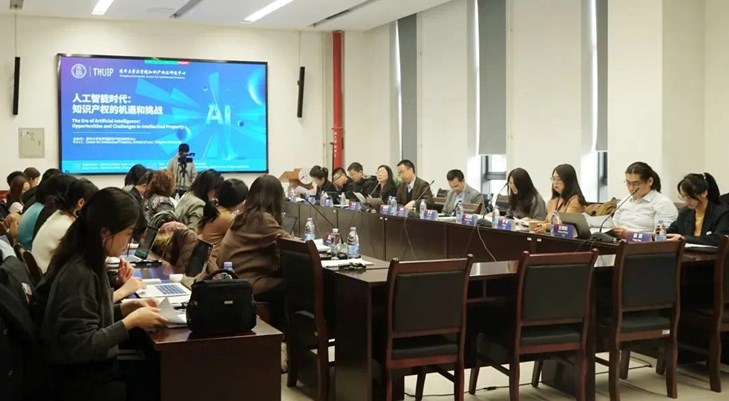
Opening Session
The conference was moderated by Dr. Hong Yan, Secretary-General of the Intellectual Property Law Research Center of Tsinghua University School of Law. In the opening session, Secretary-General Hong extended a warm welcome to all guests and expressed the hope that in-depth exchanges among the participants would spark intellectual inspiration and promote the development of intellectual property practice and research.
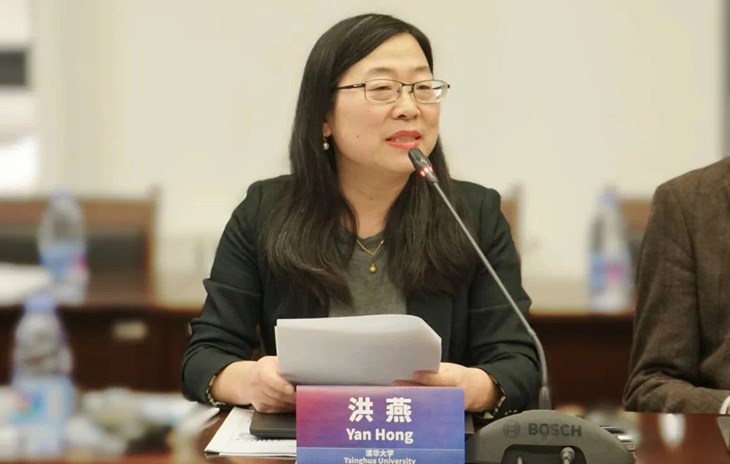
Dr. Hong Yan, Secretary-General of the Intellectual Property Law Research Center of Tsinghua University School of Law
Thematic Session – Decoding Artificial Intelligence Patents: Strategies for Success in a Complex Landscape
The theme of the first part of the conference was “Decoding Artificial Intelligence Patents: Strategies for Success in a Complex Landscape.” Dr. Roswall delivered an excellent presentation entitled “Machine Learning and Simulation: European Practice and Typical Cases.” Dr. Roswall introduced the European patent examination rules and specific cases in the field of machine learning and compared them with China’s patent examination rules in AI-related fields. Finally, Dr. Roswall summarized the key points of European patent drafting and provided practical recommendations.
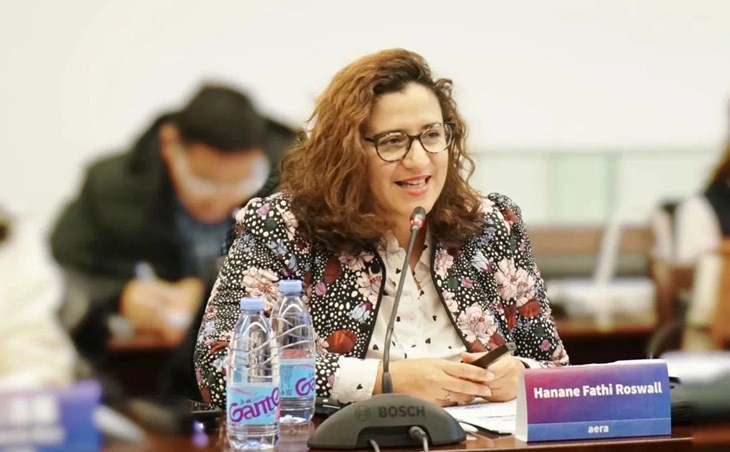
aera Partner Dr. Hanane Fathi Roswall
During the free discussion session, Professor Cui Guobin, Director of the Intellectual Property Law Research Center of Tsinghua University School of Law, engaged in an exchange with Dr. Roswall on the issue of “how to identify the specific technical field” from the perspective of patentability. Using medical diagnostic AI and automotive AI autonomous driving recognition technologies as examples, Dr. Roswall pointed out that the key to resolving this issue lies in understanding and sorting out the client’s technology. To this end, Dr. Roswall recommended identifying specific application scenarios through a process of progressive refinement and, at the same time, clarifying the technical problem and technical field through concretization such as combining with hardware, so as to meet the requirements of patentability. Corporate representatives noted that Chinese enterprises are currently concerned not only with patent applications, but also with patent value and rights protection. In the AI field, enterprises are more focused on AI patent applications at the application layer and hope that academia can provide more guidance for practice.
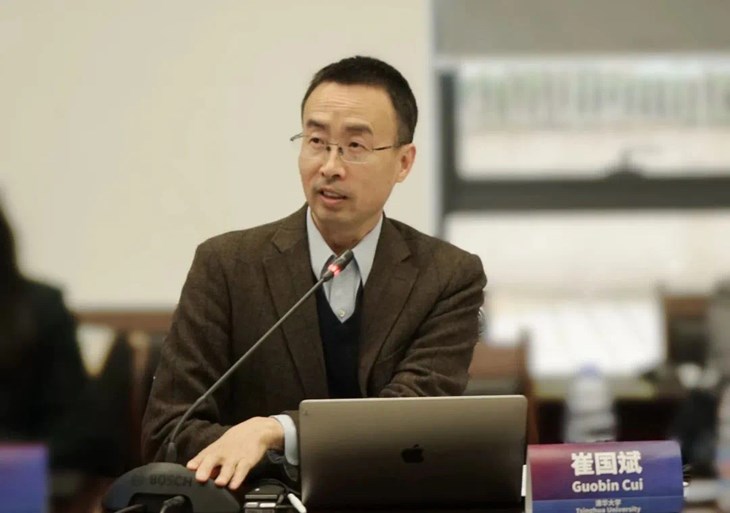
Professor Cui Guobin, Director of the Intellectual Property Law Research Center of Tsinghua University School of Law
Thematic Session – Exploring Artificial Intelligence Copyright: A Comparative Study of National Rules and Practices
The theme of the second part of the conference was “Exploring Artificial Intelligence Copyright: A Comparative Study of National Rules and Practices.” First, Ms. Jiang Nandi, Managing Partner of Lusheng Law Firm, delivered a presentation entitled “Exploring Artificial Intelligence Copyright and Data Compliance Issues: A Comparative Study of National Rules and Practices,” in which she shared her views on the copyrightability of AI-generated content (AIGC), the infringement risks and platform liability associated with AIGC, issues relating to data acquisition and use, and the fair use defense in data training. Subsequently, Attorney Zhou Jianhua delivered a report entitled “Data Collection for Machine Learning: A Southeast Asian Perspective.” Starting from the obstacles to obtaining training data, Attorney Zhou discussed issues relating to terms of use, digital rights management information, technological protection measures and anti-crawling measures in data collection, and introduced relevant provisions and judicial cases in countries such as Singapore, Malaysia and Indonesia.
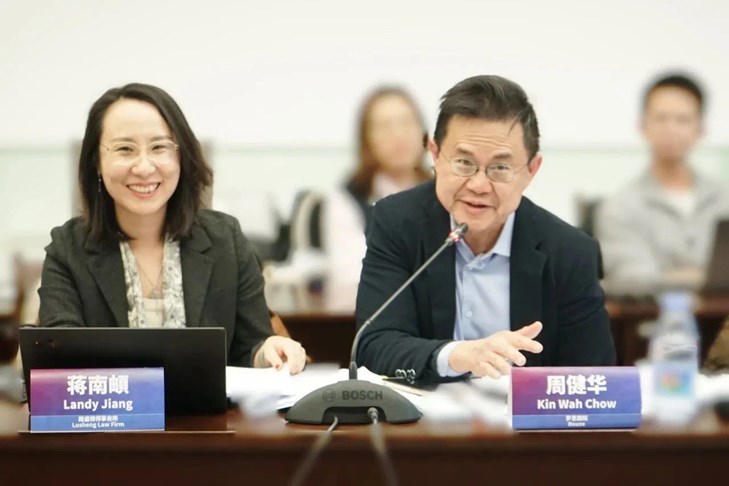
From left: Ms. Jiang Nandi, Managing Partner of Lusheng Law Firm; Attorney Zhou Jianhua, Partner of Rouse International
During the free discussion session, Chen Jinchuan, former Vice President and Judge of the Beijing Intellectual Property Court, briefly analyzed existing cases related to the copyrightability of AIGC. He considered that the existing judgments either do not provide a detailed discussion of the issue of AIGC copyrightability, or exhibit a disconnect between legal reasoning and the facts.
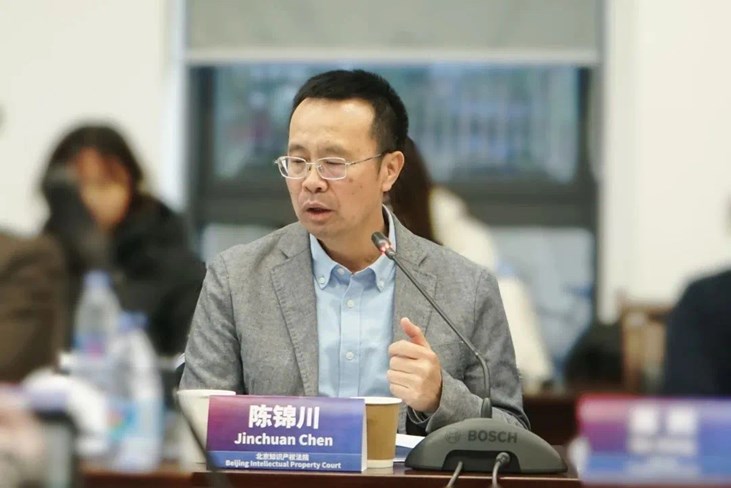
Chen Jinchuan, former Vice President and Judge of the Beijing Intellectual Property Court
Associate Professor Jiang Ge of Tsinghua University School of Law was of the view that, at the rights determination stage, the current originality standard does not impose a high requirement on user contribution, and AIGC only needs to possess a literary or artistic appearance and be sufficiently distinct from existing works and public domain content; otherwise, it would give rise to excessively high social costs in distinguishing between high-contribution and low-contribution AIGC. At the infringement stage, verbatim copying of AIGC should be found to constitute infringement, while claims going beyond verbatim copying require the plaintiff to provide evidence of further contribution.
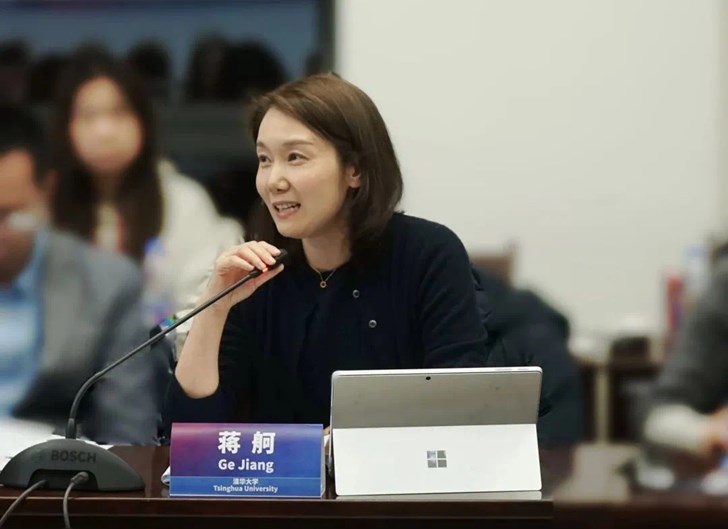
Associate Professor Jiang Ge, Tsinghua University School of Law
Representatives from multiple enterprises also shared their views on AIGC compliance and infringement issues, including how platforms should handle “notice-and-takedown” requests based on AIGC, how content providers and AI model developers can achieve win-win outcomes through cooperation, and whether platform liability is applicable in AIGC scenarios. Attorney Su Yanhong, Head of Digital and Commercial Law Practice at Lusheng Law Firm, expressed her views based on her practical experience. Professor Cui Guobin, Attorney Jiang Nandi and Attorney Zhou Jianhua also analyzed the issues from a professional perspective.
Through the enthusiastic discussions among the participants, the conference not only deepened understanding of the current situation and future development trends in the field of artificial intelligence, but also injected new vitality into multi-party exchanges and cooperation in the field of intellectual property. The academic symposium “The Age of Artificial Intelligence: Opportunities and Challenges for Intellectual Property,” organized by the Intellectual Property Law Research Center of Tsinghua University School of Law, concluded successfully.
Profiles of Lusheng Speakers
Jiang Nandi
Managing Partner; Co-Head of Dispute Resolution Practice
Lusheng Law Firm
Jiang Nandi has over 20 years of experience in intellectual property legal practice. She provides clients with comprehensive and in-depth services in IP strategy and global portfolio management and is adept at handling rights protection and litigation matters covering trademarks, copyrights, patents, trade secrets, trade names, domain names and unfair competition. She is highly trusted by numerous well-known multinational corporations and industry-leading enterprises, whose businesses span fast-moving consumer goods, luxury goods, technology and the internet, automotive, entertainment, education and publishing, among others. Ms. Jiang has represented a number of cases of landmark significance in China’s judicial practice, many of which have been recognized by courts and industry institutions, including “Annual Typical IP Cases” selected by the Supreme People’s Court and “Deals of the Year” selected by China Business Law Journal. Ms. Jiang has been recommended by many international legal ranking institutions and authoritative media, including The Legal 500, Managing IP, Benchmark Litigation and World Trademark Review, and has received honors such as “IPHouse: Top 50 Outstanding IP Lawyers in China.”
Email: ljiang@lushenglawyers.com
Su Yanhong
Head of Digital Law and Commercial Law Practice
Lusheng Law Firm
Su Yanhong has over 20 years of experience in intellectual property and legal practice and has long served numerous well-known multinational companies across industries including media and publishing, film and television entertainment, technology, advertising, the internet, fast-moving consumer goods and agriculture. She focuses on commercial law areas related to intellectual property, including technology import and export, IP assignment and licensing, franchising, non-compete arrangements and commercialization. She also provides international clients with legal advice on cross-border e-commerce and social media platforms and offers legal opinions on private traffic, marketing, endorsements and advertising compliance. At the same time, she closely follows the latest developments in China’s data protection and compliance regulation and provides specialized legal services relating to cybersecurity, personal data protection, compliance strategies and cross-border data transfers. Cases she has handled have been recognized as “Deals of the Year” by China Business Law Journal. In addition, she participated in the drafting of China’s first set of guidelines on intellectual property clauses in foreign-related economic and trade contracts, the Guidelines on Intellectual Property Clauses in Foreign Economic and Trade Cooperation Contracts.
Email: ssu@lushenglawyers.com